
VAT registration is one of those thresholds that creeps up on growing businesses – you’re not thinking about it until suddenly you’re close to it, and the rules about exactly when you need to act aren’t always intuitive. Here’s how it actually works.
The basic rule: a rolling 12-month test, not a tax-year test
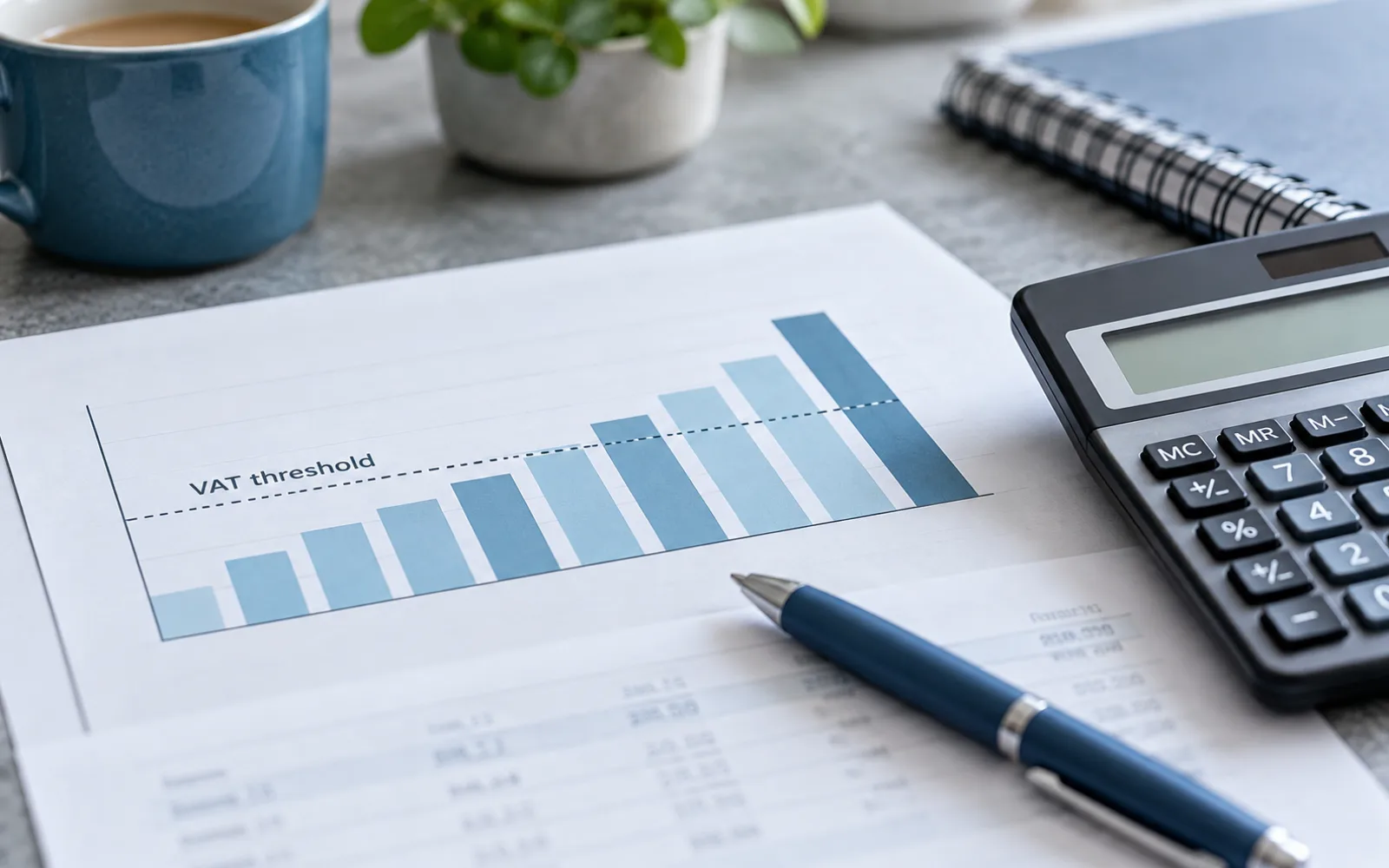
You must register for VAT once your taxable turnover goes over the registration threshold in any rolling 12-month period – not a fixed tax year, but a continuously moving 12-month window. This means you need to check your turnover regularly, not just once a year, because you can cross the threshold partway through any month, and the obligation is based on the rolling total, not an annual snapshot. [Subject to change- be sure to check VAT registration threshold against HMRC guidance.]
What counts as “taxable turnover”
This means your total sales subject to VAT (including anything at the zero rate), not your profit. A high-turnover, low-margin business can hit the threshold well before it feels like a big business in any other sense – this surprises a lot of growing businesses, particularly in retail or trades where margins are thin but sales volumes are high.
What happens once you’re over the threshold
You must register within a set deadline after going over the threshold – not whenever is convenient. Missing this deadline can mean VAT is treated as due from when you should have registered, not from when you actually did, which is an expensive way to find out you left it too late. This is one of the more painful mistakes to make, because it’s entirely avoidable with regular turnover checks.
Should you register voluntarily before you’re required to?
Sometimes, yes. Voluntary registration can make sense if:
- Most of your customers are VAT-registered businesses themselves, who can reclaim the VAT you charge them – so it costs them nothing extra
- You want to reclaim VAT on business purchases and setup costs before you’re required to register
- Looking VAT-registered lends your business credibility with certain clients
It’s generally not worth it if most of your customers are individuals or non-VAT-registered businesses, since the VAT you charge becomes a straightforward price increase they can’t recover. For example, a consultancy whose clients are all other VAT-registered companies often gains nothing by waiting to register, since those clients simply reclaim the VAT anyway – while a small business selling directly to the public may find voluntary registration makes their prices less competitive for no offsetting benefit.
Which VAT scheme fits your business
Once registered, you’ll usually have a choice of schemes – standard, flat rate, or cash accounting among others – and the right one depends on your margins, your customers, and your cash flow. The Flat Rate Scheme, for instance, can simplify your VAT calculations and sometimes leaves you better off, but the rate varies by trade sector and doesn’t suit every business – it tends to work best for businesses with relatively low VAT-able costs. This isn’t a one-size-fits-all decision, and the wrong scheme can cost a business real money over a year without anyone noticing until it’s pointed out.
Digital record-keeping is mandatory, not optional
Making Tax Digital for VAT already requires VAT-registered businesses to keep digital records and file through compatible software – this applies from registration, not as something to think about later. See our Making Tax Digital page for what that means in practice.
If you’re close to the threshold but not sure where you stand
Because the test is a rolling 12-month total rather than a fixed annual figure, it’s easy to lose track of exactly where you are relative to the threshold, especially if your sales fluctuate month to month. The practical fix is simple: review your rolling turnover regularly – monthly, if your sales are growing quickly – rather than waiting for an annual review to notice you’ve already gone over. Catching it early gives you time to register properly and, if it suits your business, decide on a scheme deliberately rather than under time pressure.
Can you deregister later if your turnover drops?
Yes – if your taxable turnover falls below the deregistration threshold (a lower figure than the registration threshold) and you expect it to stay there, you can usually apply to deregister. This isn’t automatic, though, and deregistering has its own implications worth thinking through rather than rushing into – you’ll stop charging VAT on sales, but you’ll also lose the ability to reclaim VAT on business purchases, so it’s worth modelling the actual effect on your numbers rather than assuming lower turnover automatically means deregistering is the right move.
This is exactly the kind of decision where a quick conversation beats guessing – the right call depends on your specific customer base and cost structure, not a general rule.
Approaching the VAT threshold, or not sure if voluntary registration makes sense for you?
We’ll look at your actual numbers and tell you what we’d genuinely recommend.